
Dan Smith, Seibukan Shorin Ryu
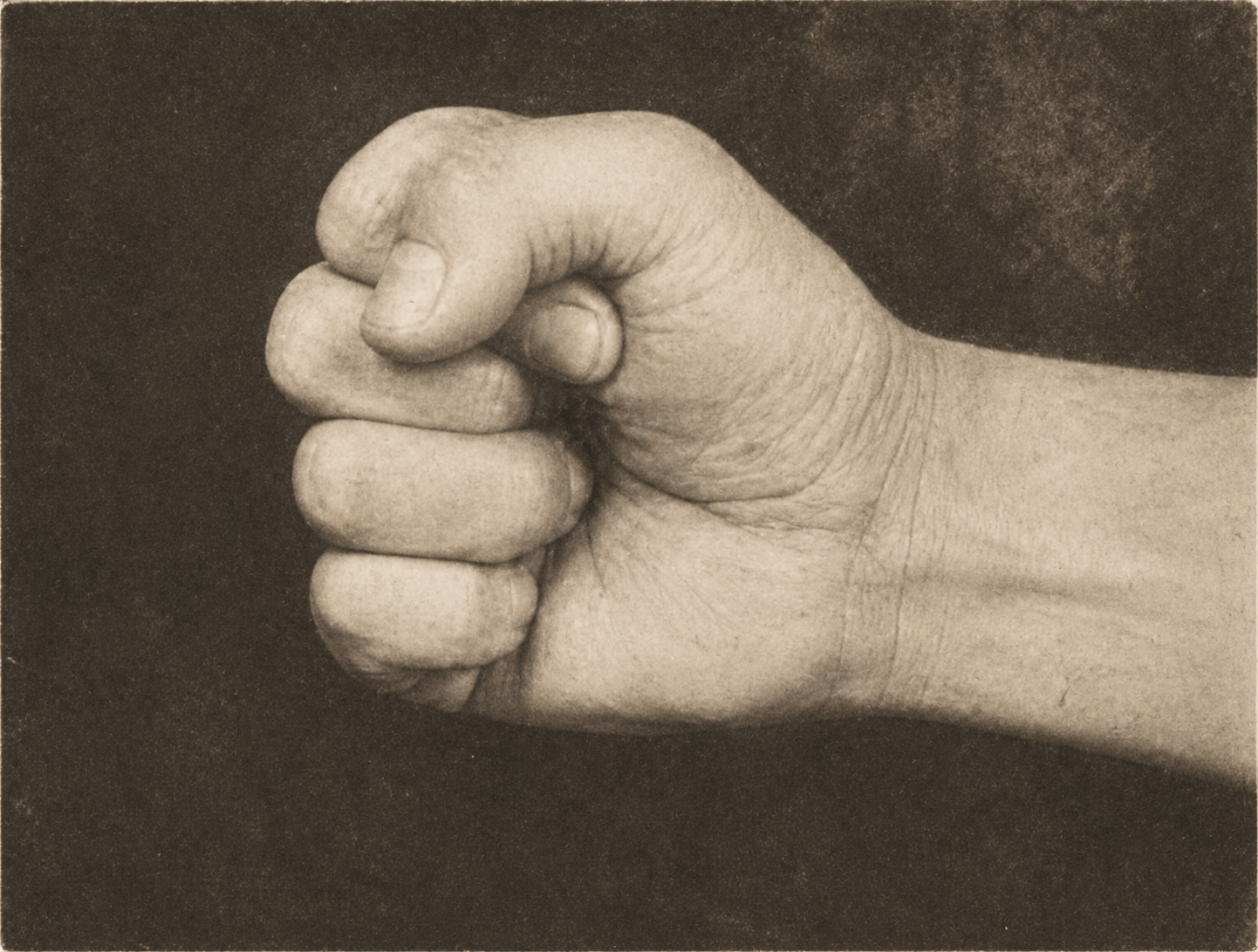
A documented reference to this method of fist formation appears in the work of Gichin Funakoshi in his text Karate-dō Kyōhan. In the 1973 edition, page 17, Figures 5 and 8 present the progressive formation of the fist. Figure 5 illustrates the transitional stage, where the fingers are brought into alignment without immediate contraction. Figure 8 shows the completed fist, where the structure is compact yet not tightly clenched.
In these images, the index finger is not fully curled in the manner commonly taught in later standardized methods. Instead, it remains extended inward, contributing to the internal alignment of the hand. The thumb rests across the index finger, providing stabilization through compression rather than by gripping across the middle finger. The resulting form is unified and structurally supported, while avoiding unnecessary tension within the hand.
This presentation indicates that the fist, as conveyed in early karate literature, was not defined by maximal contraction of the fingers, but by the establishment of alignment followed by coordinated compression. The hand is organized first, then compressed, allowing for efficient transmission of force and immediate adaptability.
The structure described here is defined by the index finger extending straight down into the palm, pressing into the area just below the base of the thumb. The middle, ring, and little fingers are curled into the palm to complete the closure of the hand. The thumb crosses only the index finger and does not contact the middle finger. The first joint of the thumb is positioned over the middle joint of the index finger, applying downward compression.
This creates a compressed fist rather than a tightly clenched one. The distinction between compression and tension is critical. A fully contracted fist—where all fingers are tightly curled and squeezed—introduces localized tension that can inhibit the free transmission of force. In contrast, compression organizes the structure of the hand without excess muscular contraction, allowing the force generated by the body to pass through with minimal internal resistance.
This condition directly supports the expression of chinkuchi at the moment of impact. The hand is not pre-tensed into rigidity; rather, it remains structurally prepared so that compression can be instantaneously realized at contact. The result is a sharper, more unified discharge of power.
The index finger functions as a structural bridge rather than a gripping digit. The thumb provides stabilization through compression, and the remaining fingers provide closure without introducing excessive tension. This allows the hand to remain responsive and integrated with the movement of the body.
The “Shuri-te” fist can be somewhat more difficult for someone unfamiliar with it to form quickly. However, transitioning from this fist to a grasping or hooking hand is not difficult, nor is moving into a spear hand or other open-hand configurations. With long-term practice, the formation becomes natural; after decades of use, it is no longer consciously noticed.
The advantages are clear. The fist presents a flatter striking surface, particularly useful for angled punches or shaken. More importantly, the compression is superior to that of the “curled” fist. This improved compression allows for lighter, more efficient movement of the hand and enhances the quality of impact. Striking the makiwara, in particular, is noticeably more effective.
When I first arrived on Okinawa in 1969, this method of forming the fist was widely practiced. I had encountered it earlier during my training in Shotokan, which led me to examine more closely the rationale behind extending the index finger toward the base of the thumb. This positioning prevents the thumb from crossing over to the middle finger and contributes to the overall structural integrity of the fist.
In the dojo where I trained, both fist formations were used. When the “compression” fist was not employed, the thumb was placed on the middle joint of the index finger. While this represents only a slight variation, it produced a similar functional effect. Reducing tension in the index finger and hand overall yielded nearly the same benefits in terms of structure and efficiency.
Because the fist is not over-contracted, it permits immediate transition to grasping, hooking, or open-hand techniques without delay. This reflects the functional requirement of close-distance engagement, where receiving, controlling, and striking are continuous rather than separate actions.
This method of forming the fist represents a functional condition rather than a stylistic variation. It reflects an approach in which compression is prioritized over tension, structure over contraction, and integration over isolation.
“Put the movement in your body, not your mind.”
— Zenpo Shimabukuro
Listening to Okinawa Karate



Leave a Reply