
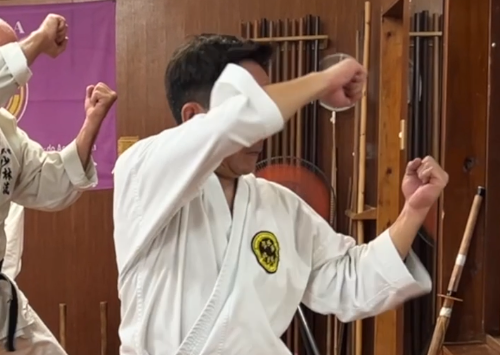
Wari Uke – Internal Mechanics
In this video we explore several key principles of Okinawan karate—Wari Uke, Gamaku, and Nagare—with clear demonstrations that show how these ideas actually function inside the body.
Wari Uke, often translated as “splitting block,” uses both hands working together at close range. Because of this, it is commonly described as a close-range receiving action.
The movement begins from a relaxed state in Shiko Dachi, with the body settled and ready—what we call Nage, the prepared condition.
A slight turn of the Tanden to the rear begins the motion, initiating the internal figure-eight pathway. As the hips continue this pattern, Gamaku—the action of the waist and obliques—drives the Tanden forward.
As the energy moves forward, Ku-ichi (natural dropping) combines with Chinkuchi (momentary structural tightening). Together they produce Muchimi, the heavy, connected quality felt through the arms when receiving force.
Breathing occurs naturally through this process. This is Nagare, or natural breath. As Gamaku presses downward through the lower abdomen, the diaphragm lowers and air flows into the lungs without lifting the chest or forcing the breath.
When the internal mechanics are missing, the movement becomes stiff and loses the whipping action that produces maximum effect with minimal effort.
When the cycle is correct, the body completes the motion cleanly and immediately resets—ready for the next movement.
This is the essence of Wari Uke performed with true Okinawan internal mechanics.


Leave a Reply