Dan Smith
Dan Smith, Hanshi – Seibukan Shorin-ryu Karate
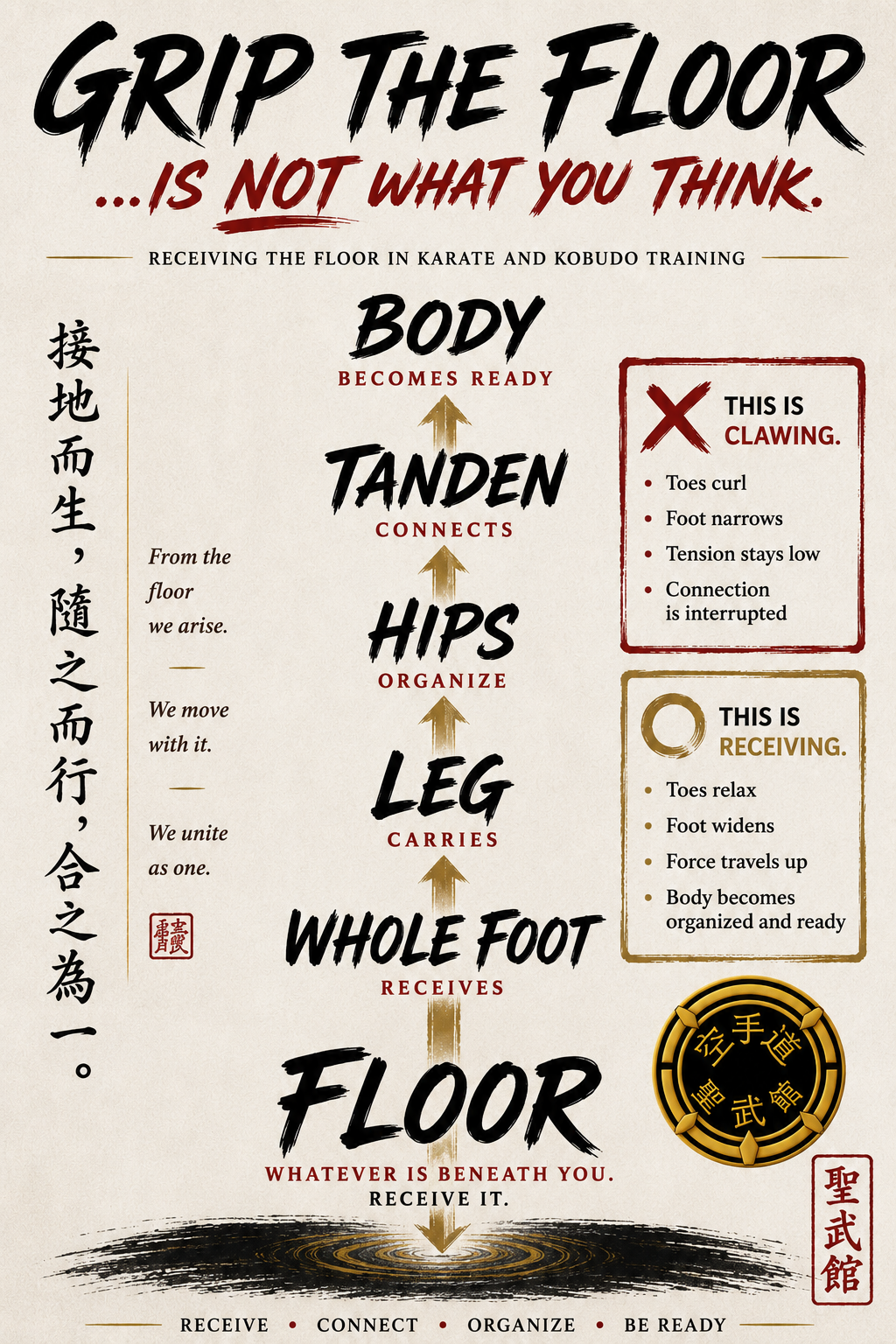
Understanding the difference between compression and tension is essential to understanding how power is produced, expressed, and preserved in Shorin-ryu karate. Although both involve muscular activity and force within the body, they function in fundamentally different—and often opposing—ways.
Compression refers to the inward and downward organization of the body’s mass through sinking (ku-uchi), alignment, and elastic structural support. Compression unifies the body so it functions as a single mass rather than as disconnected parts. Importantly, compression is elastic rather than rigid; it stores potential energy without sacrificing responsiveness or mobility.
Tension, by contrast, is characterized by outward and dispersive muscular contraction. Tension pulls joints apart, stiffens the body, and fragments movement. While tension may feel strong or stable, it disrupts alignment, blocks clean transmission of force, and causes power to leak before it can be expressed.
In the production of power, compression and tension work in opposition. Compression organizes force inward so it can be stored, directed, and released. Tension pushes force outward prematurely, preventing accumulation and converting potential power into effort and momentum.
Effective Shorin-ryu movement relies on vertical sinking and inward compression as prerequisites for outward vertical and horizontal expression. Vertical sinking establishes resistance and stability. From this compressed state, torque can accumulate around the center of the body and be released suddenly and decisively. Outward expression is supported by compression; it is never created by tension.
Dynamic movement is neither good nor bad by itself. Movement becomes healthy and powerful when it is supported by compression, alignment, and control of the center. In this condition, the body moves as a unified structure, joints are protected, and elastic tissues load and unload safely.
Dynamic movement becomes harmful when tension replaces compression. Movement driven by tension forces joints to absorb load, reduces elasticity, and accelerates wear over time. In this condition, motion replaces power, and force dissipates rather than being delivered.
At the moment of release, compression does not disappear. Instead, it continues to support outward expression without becoming tension. Immediately after release, compression is re-established through fast stopping, preventing dissipation and preserving balance and readiness.
Historically, Okinawan karate preserved different body methods for different purposes. Tension-based methods were used primarily for conditioning, breath control, and structural hardening. Shorin-ryu preserved a compression-based method oriented toward immediate expression of power, adaptability, and continued mobility.
Problems arise when these methods are confused. Introducing tension-based conditioning into Shorin-ryu movement replaces elasticity with rigidity, undermines torque, delays release, and reduces effectiveness. When compression is maintained and tension is avoided, Shorin-ryu power remains efficient, scalable, and sustainable over a lifetime.
In summary: compression enables power while tension undermines it. Compression stores and organizes force; tension disperses it. Vertical sinking and inward compression are prerequisites for effective outward movement. Movement itself is not the problem—loss of compression is.


Leave a Reply