Share on Facebook

Early Contact, Late Contact, and Receiving After Recognition

Dan Smith, Hanshi – Seibukan Shorin Ryu

Kata is often misunderstood as a sequence of pre-selected techniques responding to pre-selected attacks. In reality, kata functions as a doctrinal training method designed to condition the defender’s body to manage force before conscious recognition of the attack occurs. Central to this doctrine is the relationship between distance, timing, and the choice to repel early or receive late.

Distance and the Nature of Danger

An attack is not equally dangerous at all moments. The beginning of an attack—when intent is forming and motion is initiating—is structurally weaker and less dangerous than the end of an attack, when mass, momentum, and intent are fully committed. Kata acknowledges this reality by training the defender to operate at multiple distances and timings rather than reacting at the point of maximum danger.

Early Contact: Repelling or Stopping

When distance and timing allow, early contact is preferred. Early contact occurs before the attacker’s structure has fully organized and before momentum has matured. At this range, repelling or stopping actions are effective because the defender is engaging intent rather than force. Kata encodes this option through forward pressure, angular stepping, and actions often mislabeled as simple blocks. These movements train the body to interrupt, jam, or displace an attack while it is still forming.

Late Contact: Absorbing and Receiving

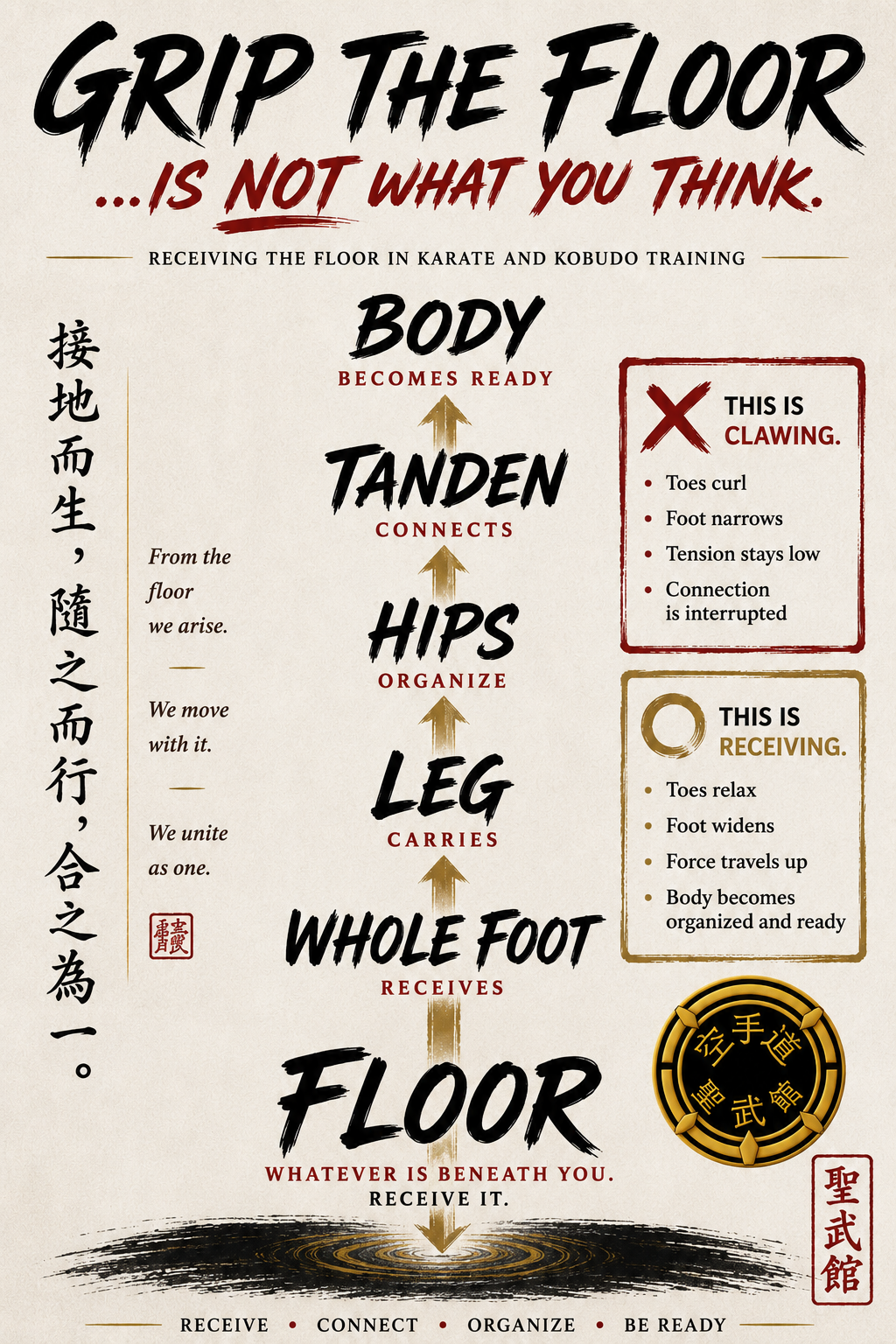
Late contact occurs when the attack has already matured or distance has collapsed. At this stage, attempting to repel force directly is structurally unsound. Kata therefore trains absorbing and receiving as a necessary option. Receiving does not mean yielding or retreating; it means aligning the body to accept incoming force without opposition, dispersing it through structure, and preventing collapse. Movements that appear passive externally are in fact highly conditioned methods of maintaining balance and readiness under pressure.

Receiving Proceeds Recognition

A critical functional principle is that receiving must occur before conscious recognition of the attack. In real conflict, there is insufficient time to identify the exact nature of an attack before contact is made. Kata addresses this by conditioning the body to default to correct receiving behavior automatically. Structure, posture, and alignment are established first; recognition and counteraction follow. This sequence ensures that the defender is never structurally compromised while attempting to identify what is happening.

Why Kata Is Fixed

Kata uses fixed sequences to remove uncertainty during training so that internal relationships can be reliably conditioned. By fixing posture, direction, and movement, kata allows the practitioner to repeatedly experience early and late contact scenarios without distraction. Over time, the body learns when to repel early and when to receive late, independent of conscious decision-making.

Summary

Kata does not teach the defender to react to known attacks. It conditions the defender to manage force across distance and time. Early in an attack, repelling or stopping is viable and preferred. Late in an attack, absorbing and receiving becomes necessary. In all cases, receiving precedes recognition. Through fixed form, kata produces adaptability, allowing the defender to function effectively against unknown attacks.

Trending

Leave a Reply

Discover more from Listening to Okinawa Karate

Subscribe now to keep reading and get access to the full archive.

Continue reading